
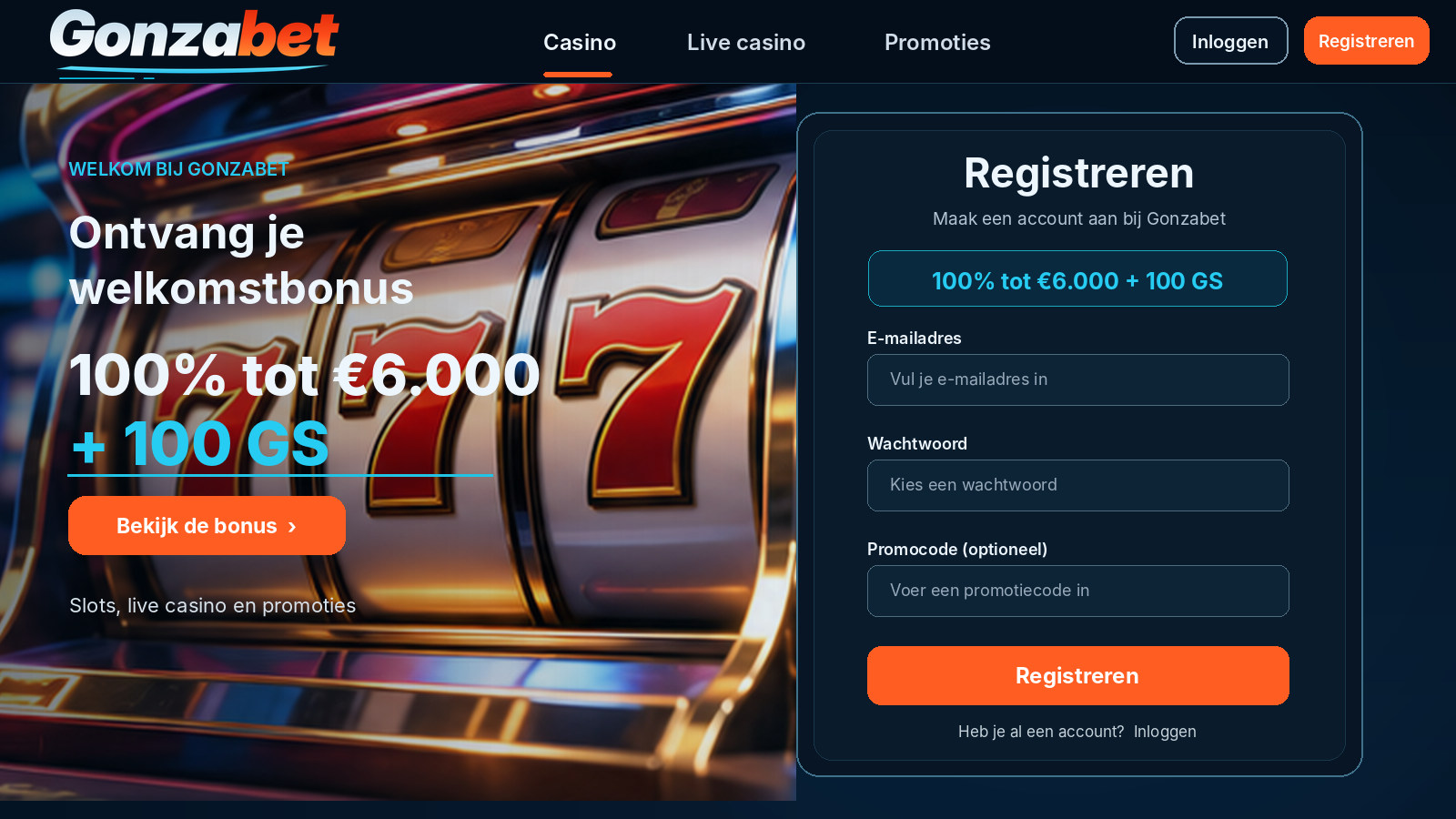
Gonzabet Casino is associated with a headline welcome promotion of 100% up to €6,000 plus 100 free spins. The large figure describes a ceiling on possible promotional credit rather than money owed to a customer. The spin allocation is a different component whose practical value depends on the applicable rules.
This explanation looks at the financial meaning of a deposit match, the restrictions that may apply to promotional funds and the distinction between an account balance and cash that can actually be withdrawn. A promotion does not reduce the underlying risk of gambling or establish that the service is authorized in a particular country.
| Welcome offer | 100% up to €6,000 + 100 free spins |
| Match percentage | 100% |
| Maximum promotional credit | €6,000 |
| Free spin allocation | 100 rounds |
| Typical bonus restrictions | Wagering, eligible games, stake limits and expiry |
| Promotional funds | Separate from withdrawable cash |






What a percentage match actually describes

A match percentage refers to the relationship between a qualifying payment and a possible promotional credit. A 100% match means that the nominal credit equals the eligible amount until the applicable award ceiling is reached. The percentage does not describe a probability of winning, a return on an investment or an entitlement to withdraw the resulting balance as cash. Promotional credits may have contractual restrictions that do not apply in the same way to an ordinary cash deposit.
The €6,000 ceiling in the Gonzabet headline is large relative to ordinary household spending. A simple example helps distinguish the percentage from that ceiling. If a hypothetical qualifying deposit were €100, a 100% match would correspond to €100 of promotional credit under the stated structure, not €6,000. The ceiling would have no effect on that example. Increasing a deposit merely to approach an advertised maximum increases the amount of personal money at risk and does not establish any future withdrawal entitlement. Similarly, the 100 free spins are an allocation of rounds, not €100 in cash. Their nominal stake value and any payout restrictions require separate terms. Neither component should justify spending beyond an independently chosen financial boundary.
A round allocation is not a cash denomination
The free-spin component specifies a quantity of rounds. It does not, by itself, specify the denomination of each round or the title on which the rounds can be used. Those details determine the nominal amount of gameplay associated with the allocation, while the game's random outcome mechanism determines whether the rounds produce any prizes.
Promotional rounds can be attached to one or more designated games. Depending on the terms, a customer may be unable to alter the stake setting or exchange an allocated round for cash. Any resulting awards may be recorded in a promotional ledger rather than as immediately withdrawable money. An advertisement that lists a round count without explaining these conditions offers only a partial picture. One hundred spins does not mean one hundred successful outcomes, and the existence of an allocation does not make playing with additional personal funds necessary.
Understanding wagering requirements
A wagering requirement is a contractual turnover condition that may apply to a promotional balance or to amounts derived from a promotion. A multiplier is only meaningful when the calculation base is defined. In some offers the base is the promotional credit alone; in others it includes additional amounts. The relevant terms should identify the basis and specify which activity qualifies toward the required turnover.
Wagering volume and net expenditure are not the same measure. A recorded series of stakes can generate a large turnover figure while the player's available balance declines. The amount shown on a progress indicator may therefore provide very little information about whether the player will retain any funds. Some game categories can count differently toward turnover or be excluded from a promotion altogether. Completing a contractual requirement does not guarantee a profit. It is important not to treat a turnover target as a financial objective that must be achieved regardless of the consequences.
How separate balance categories affect withdrawals
A gambling interface may display a cash balance alongside promotional credit and a separate amount described as available for withdrawal. These categories can behave differently. The terms may specify the order in which funds are used and the category to which a resulting award is assigned. A single large balance figure does not necessarily show how much money could be released from the account.
The distinction becomes particularly important when a player wants to stop. If promotional credit is removed, the operator's rules may affect associated awards differently from money that was originally deposited. The relevant financial record should identify each category and the adjustments applied to it. A customer should not have to infer the contractual status of funds from the color or position of a balance indicator. Where a balance is disputed, preserving the existing transaction history is more useful than adding new funds in an attempt to change the status of the account.
Game contribution rules and stake restrictions
Promotions can distinguish between a slot, a table game and other products when measuring qualifying activity. A special feature purchase or a side wager can also be treated differently from an ordinary game round. The contribution of a game is a contractual accounting rule; it does not describe how likely the game is to produce a prize.
A maximum stake condition, where one applies, places a boundary on what an operator considers permissible promotional activity. This is not a recommendation to stake an amount near that boundary. A smaller wager still involves financial risk. It is also possible for a service to define the total stake differently when several components are purchased in the same round. Conditions taken from another casino or a different promotion are not reliable evidence of the rules attached to the Gonzabet offer. The specific terms govern the relationship between eligibility, turnover and any restriction on the promotional balance.
Promotion deadlines and the pressure of countdowns
An offer may have a qualification window, a period in which allocated credit can be activated and a separate expiry date for using it. These deadlines should not be collapsed into one assumption about when all associated funds expire. A change in the status of an offer may be accompanied by an adjustment to the balance, depending on its terms.
Countdowns and reminders are common marketing devices because they create a sense of urgency. They do not establish that acting quickly is financially beneficial. If understanding an offer requires more time than a deadline permits, it is reasonable to let the offer pass. The same applies when an impending expiry conflicts with a decision to stop gambling. There is no obligation to use the full allocation of promotional rounds. A decision about personal finances should not be delegated to a timer displayed in an advertising panel.
Campaign codes and customer eligibility
An incentive can be linked to an account through a campaign code, an explicit selection or an automated assignment. These mechanisms describe how an offer is administered, rather than the value of the offer itself. The presence of a campaign code on a website does not establish that the code is genuine, current or available to every customer.
Eligibility rules may address residency, age, account history, currencies or other contractual conditions. A service may also distinguish between a first deposit and subsequent payments. It is important that a reader does not infer the existence of additional benefits from a single headline. The stated Gonzabet promotion describes one match amount and one round allocation. Other promotional categories, such as reload rewards, loyalty points or seasonal campaigns, are familiar across the sector but are distinct from that stated offer. They should not be added to its advertised value without a basis in the actual terms.
Ending an active promotion
The consequences of cancelling a promotion depend on its applicable conditions. Remaining promotional credit may expire, while associated awards may be treated under separate rules. The handling of personal deposits and settled amounts should be clearly distinguished from the removal of promotional funds. A request for clarification can identify the contractual basis of an adjustment without requiring the player to make another payment.
Someone who no longer wishes to gamble does not have to continue because a progress indicator shows that a condition is partly completed. Past expenditure is already incurred, and a further stake introduces an additional uncertain outcome. The possibility of retaining a promotional amount is not a reason to disregard a spending limit. If ending an offer appears difficult, independent consumer or gambling support may be useful. Keeping a dated account of existing balances and communications can also help when an explanation from the operator is needed.
Legal availability and the limits of the offer
A Costa Rican company registration is not a dedicated online gambling licence. Local authorization is a separate question that depends on the actual service and jurisdiction. A brand name, a mobile interface or a welcome offer does not establish legal availability. Where the necessary authorization is absent, a promotional offer should not be treated as available to the reader.
The promotion also does not eliminate the need for responsible financial decisions. Gambling should never be funded with money needed for housing, food, bills or debt repayment. If the prospect of losing a bonus makes it difficult to stop, that pressure is itself a reason to reassess participation. People who have chosen self-exclusion should maintain that decision rather than looking for another offer. The advertised match and spins are marketing incentives, not a source of income or a means of recovering previous losses.